

Entity IDs, Andromeda and the New Era of Creative Led Targeting on Meta
.png)
Table of content:
For most of the last decade, scaling Meta accounts followed a familiar playbook.
Refine audiences.
Layer interests.
Build lookalikes.
Segment the funnel.
Optimise exclusions.
Creative mattered, of course. But targeting was the lever.
That model is breaking.
As Meta’s AI-driven delivery systems evolve, particularly under Andromeda, scale is increasingly driven by creative signals rather than audience inputs.
In practical terms, creative is no longer just the message.
It is the targeting system.
And if you are not structuring your creative strategy around Entity IDs, you are likely capping your own growth.
What Is an Entity ID and Why Does It Matter?
Every ad you build in Ads Manager receives a Creative ID.
But behind the scenes, Meta assigns something more important: an Entity ID.
An Entity ID is essentially a visual fingerprint. It groups together ads that Meta determines are visually identical or materially similar.
This distinction matters more than most brands realise.
You can duplicate an ad, change the headline, adjust the primary text, and even alter minor design elements. That will generate a new Creative ID.
It will not necessarily generate a new Entity ID.
If Meta considers the imagery structurally similar, those ads are grouped together and share:
- Learning signals
- Delivery patterns
- Audience pools
- Optimisation data
Which means your “new” creative may simply be feeding an existing learning bucket rather than creating a new one.
And that is where many brands unknowingly stall.
The Illusion of Creative Testing
One of the most common issues we see across performance accounts is false diversification.
Teams believe they are running creative tests. In reality, they are running copy swaps on similar visuals.
For example:
- The same skincare product shot with a different offer
- The same flat lay with slightly different lighting
- The same composition with new overlay text
To a human, these feel different.
To Meta’s machine learning systems, they may look functionally identical.
When creatives share an Entity ID, they optimise together. That can be efficient in early testing phases, but it limits incremental scale.
You think you launched five new ads.
Meta thinks you launched one.
This is often why brands increase creative volume yet see no meaningful expansion in reach or performance.
True scale requires true differentiation.
What Actually Creates a New Entity ID?
If you want fresh learning and access to new audience cohorts, you need meaningful creative divergence.
Minor edits rarely qualify.
Significant changes usually do.
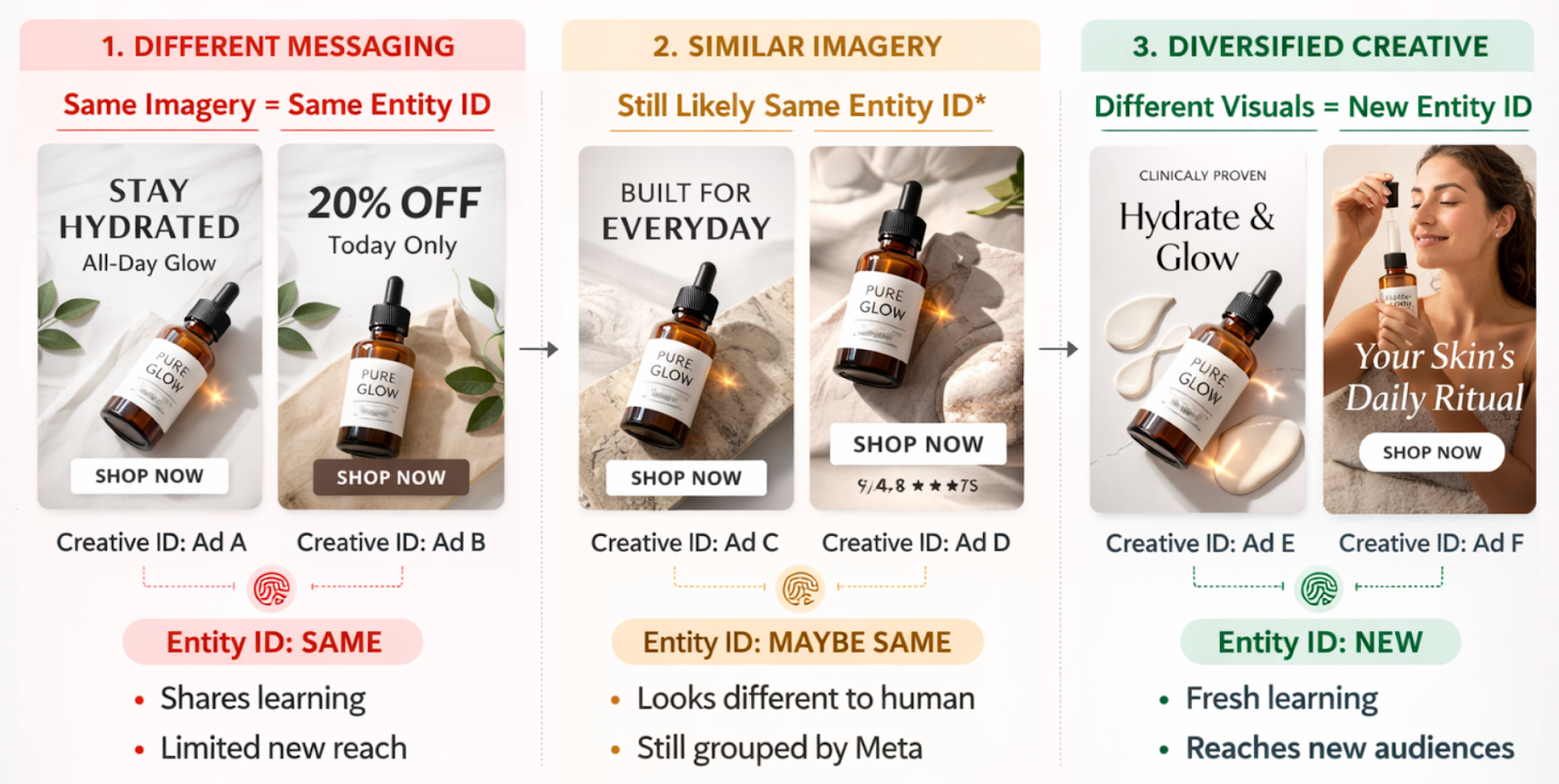
Illustration: Identical imagery vs similar imagery vs true diversification and how each impacts Entity ID grouping.
In the visual above, three common scenarios are illustrated.
In the first, messaging changes but the imagery remains identical. Result: same Entity ID.
In the second, the product angle and lighting shift slightly. It looks different to a human eye, but Meta may still cluster it under the same fingerprint.
In the third, the environment, storytelling context, and visual language change meaningfully. Result: a new Entity ID, fresh learning, and access to new audience pools.
That third scenario is where incremental scale lives.
What Meaningful Divergence Actually Looks Like
If you want to increase the probability of generating new Entity IDs, your creative needs structural differences.
In practice, that usually means:
Different Environments
Studio shot versus real world usage.
Product on white background versus product in someone’s bathroom routine.
Human Inclusion
Product only versus product in hand.
Clinical flat lay versus testimonial style content.
Format Diversification
Static versus vertical video.
Polished brand asset versus native looking short form content.
Storytelling Angle
Educational breakdown versus emotional transformation.
Routine integration versus limited time offer.
Thumbnail Variation
In video specifically, thumbnails matter. Two videos with identical thumbnails may still be grouped together.
Small detail. Big impact.
The principle is simple:
Entity ID diversification is concept diversification.
Not colour tweaks. Not headline swaps. Concept.
If your team struggles to generate genuinely distinct ideas at scale, we’ve compiled 100 ecommerce ad templates designed to spark structural creative diversification across funnels.
Andromeda and Creative Led Delivery
Meta’s delivery systems are increasingly responsible for audience exploration.
Advantage+ campaigns, automated placements, and AI optimisation reduce reliance on granular targeting inputs.
In this environment, creative becomes the most powerful lever you control.
Instead of manually discovering new audiences, your role shifts to providing the algorithm with a diverse set of creative signals.
Each new Entity ID behaves like a new seed:
- It enters its own learning phase
- It explores new delivery patterns
- It accesses new audience cohorts
If you continue to feed the system near identical creative, you recycle the same demand pool.
If you introduce truly distinct concepts, you expand the surface area of exploration.
This is not a tactical tweak.
It is a structural shift in how growth works.
Creative Diversity and the Surround Sound Effect
Creative diversification does not just improve delivery mechanics.
It improves persuasion.
When a potential customer sees the same message repeatedly, fatigue increases and relevance declines.
But when they encounter multiple angles from the same brand:
- Clinical proof
- Lifestyle integration
- Social proof
- Creator testimonial
- Promotional incentive
The product becomes relevant in multiple contexts.
This layered exposure builds familiarity and intent.
We often describe this as a surround sound approach to creative.
Instead of repeating one message louder, you reinforce multiple messages strategically.
When delivery systems reward diversity and consumer psychology responds to it, performance compounds.
Why Partnership Ads Accelerate Diversification
One of the most efficient ways to generate new Entity IDs is through partnership ads and creator content.
Creators naturally introduce:
- Different faces
- Different filming styles
- Native to platform storytelling
- Varied pacing and hooks
This variation increases the likelihood of new fingerprints.
More importantly, it introduces creative language that feels authentic to the platform, particularly in vertical video environments where a large proportion of time is spent.
A studio production may produce multiple versions of one visual theme.
A well structured creator collaboration can produce multiple distinct concepts from a single partnership.
When approached strategically, partnership ads are not simply an influencer tactic.
They are scale infrastructure.
We explore this in more detail in our guide to Partnership Ads on Meta in 2026, including how to structure creator hooks to maximise diversification.
What This Means for Your Meta Strategy
If you want to scale in an AI led ecosystem, your creative process must evolve.
At Webtopia, we now plan creative with Entity ID diversification in mind from the concept stage, not after performance plateaus.
That means:
- Planning distinct concepts across funnel stages
- Prioritising volume of ideas over micro visual edits
- Designing with format diversification built in
- Briefing creators for multiple hooks and narrative variations
- Auditing accounts for duplication risk
The question is no longer:
Have we launched enough ads?
The question is:
Have we launched enough distinct concepts?
The Takeaway
Growth on Meta no longer comes from manually finding new audiences.
It comes from giving the system new creative signals so it can find them for you.
Every new Entity ID represents:
- A fresh learning opportunity
- A new delivery pathway
- A hedge against fatigue
- A chance at incremental scale
In 2026, creative is not just the ad.
It is the targeting system.
Brands that understand this will scale.
Brands that continue relying on micro edits and copy swaps will plateau.
The difference is not effort.
It is structural creative thinking.
Author: Arun Easwaran
Get weekly expert insights!
.png)

.png)
.png)
Turn your ad spend into real growth.
At Webtopia, we don’t just run ads. We build scalable growth systems designed for ambitious DTC brands. By combining performance marketing, creative strategy, and data-backed execution, we help founders scale without sacrificing profitability. Our clients see an average 6X blended ROAS every month, because great brands deserve more than short-term wins.
Book your call today and let’s build your next growth chapter together.
