

When Meta ads stop converting: an ecommerce diagnostic
.png)
Table of content:
When Meta ads stop converting, the instinct is to start changing things in the ad account fast. That instinct usually makes the problem worse. The cause is more often downstream of the ads than inside them, so the smart move is to work the whole funnel backwards before you touch a single campaign. This guide gives you the diagnostic order we use, so you can find the real cause instead of guessing.
Every founder spending real money on paid social has lived through the same week. Return on ad spend was steady, then it was not. Cost per purchase crept up, the dashboard turned red, and the group chat filled with theories. Before you pause campaigns or rebuild the account, it helps to remember one thing about why Meta ads are not converting: the ad account is the last place most of these problems actually live, not the first.
What follows is a calm, ordered diagnostic. The point is to confirm where the breakage is before you act, because the wrong fix applied confidently can cost you a month of learning and a chunk of budget.
Why Meta ads not converting is usually a funnel problem
An ad does one job. It earns a click. Everything that determines whether that click becomes revenue happens after the ad: the measurement layer that reports the result, the landing experience, the offer, the checkout, and what happens to that customer afterwards. When founders say performance fell off a cliff, the ads themselves are frequently doing the same job they did last month. Something further down the chain changed, and the ad account is simply where the symptom shows up.
So the diagnostic runs in a deliberate order, from the most common and least visible causes to the deepest commercial ones. Resist the urge to skip ahead.
Step one: confirm the drop is real
Before anything else, rule out a measurement artefact. A surprising share of sudden conversion drops are not drops at all. They are gaps in what Meta can see.
Check tracking and the Conversions API
If your server-side tracking through the Conversions API has degraded, or a recent site change broke an event, Meta loses visibility on purchases that are still happening. Cross-check your ad account numbers against your Shopify revenue and your own analytics for the same window. If Shopify shows orders that Meta does not, you have a tracking problem, not a converting problem.
Account for iOS and attribution windows
Signal loss from iOS privacy changes and shortened attribution windows means platform-reported conversions undercount what is really happening. Look at your blended metrics, things like total revenue divided by total spend, alongside the in-platform numbers. If blended performance is stable while the dashboard looks grim, the business is fine and the reporting is lying to you.
Step two: creative fatigue and frequency
Once you trust the numbers, look at creative. This is the most common genuine cause of a real decline. Audiences see the same ads repeatedly, response drops, and cost rises.
Check frequency at the campaign and ad set level. Rising frequency alongside falling click-through rate is the classic fatigue signature. Look at how long your top performers have been running unchanged. If your best ads are months old and you have not introduced fresh angles, the audience has simply seen them too often. The fix is new creative built on new angles, not a budget change on tired assets.
Step three: audience and offer match
Next, ask whether the right message is reaching the right person. Broad targeting paired with a narrow product can misfire, and a recent change to audiences, exclusions or campaign structure can quietly shift who sees your ads. If you have recently consolidated campaigns or changed your targeting setup, line up the timing against when performance moved. Coincidences here are rare.
This is also where ad format matters. If you are leaning only on standard formats, there are structural options worth testing, and our guide to Meta partnership ads for DTC covers one of them in detail.
Step four: landing page and site speed
The click landed. What happened next? A meaningful share of conversion problems sit on the page, not in the feed. Pull up your landing page conversion rate for the affected period and compare it to your baseline. If the rate fell, the ads are doing their job and the page is losing the sale.
Common culprits: a page that loads slowly on mobile, a message that does not match the ad that sent the visitor there, a price reveal that surprises, or a checkout that added friction. Site speed matters more than most founders accept. Every second of load time on mobile costs you conversions, and a recent theme update or new app can quietly slow the whole site down. Test the actual journey on a phone, on mobile data, as a first-time visitor would experience it.
Step five: the offer and the competition
If tracking is clean, creative is fresh, targeting is sound and the page converts, look harder at the offer itself. Markets move. A competitor may have launched a stronger promotion, shifted pricing, or simply outspent you in the auction for the same season. Meta's own auction dynamics mean that when more advertisers compete for your audience, your costs rise even if nothing about your ads changed.
Ask the honest question. Is the offer still compelling against what your customer can now find elsewhere? Sometimes the ad account is reporting a real change in the market, and the answer is a sharper offer rather than a new campaign. The same competitive pressure shows up across channels, which is why we have written about defending performance through platform shifts like Google's forced migration to AI Max and negative keyword governance.
Step six: what happens after the first order
Here is the step most diagnostics miss. Sometimes the ads are converting fine and the real problem is profitability, not acquisition. If your cost to acquire a customer rose while your repeat purchase rate stayed flat or fell, the ads look broken because the maths behind them stopped working, not because they stopped performing.
Acquisition and retention are one system. The amount you can afford to pay for a first order depends entirely on what that customer is worth over time. If retention softens, your viable acquisition cost falls with it, and paid social is the first place that shows. This is why we treat the two as a single picture rather than separate departments. Our sister brand Oaks handles the retention and email side through Klaviyo precisely because a healthy flow programme changes what the ad account can sustainably spend.
Before you conclude the ads are the problem, pull your repeat rate and your contribution margin per order for the same window. If those moved, the fix is commercial, and no amount of creative testing will solve it.
The diagnostic checklist
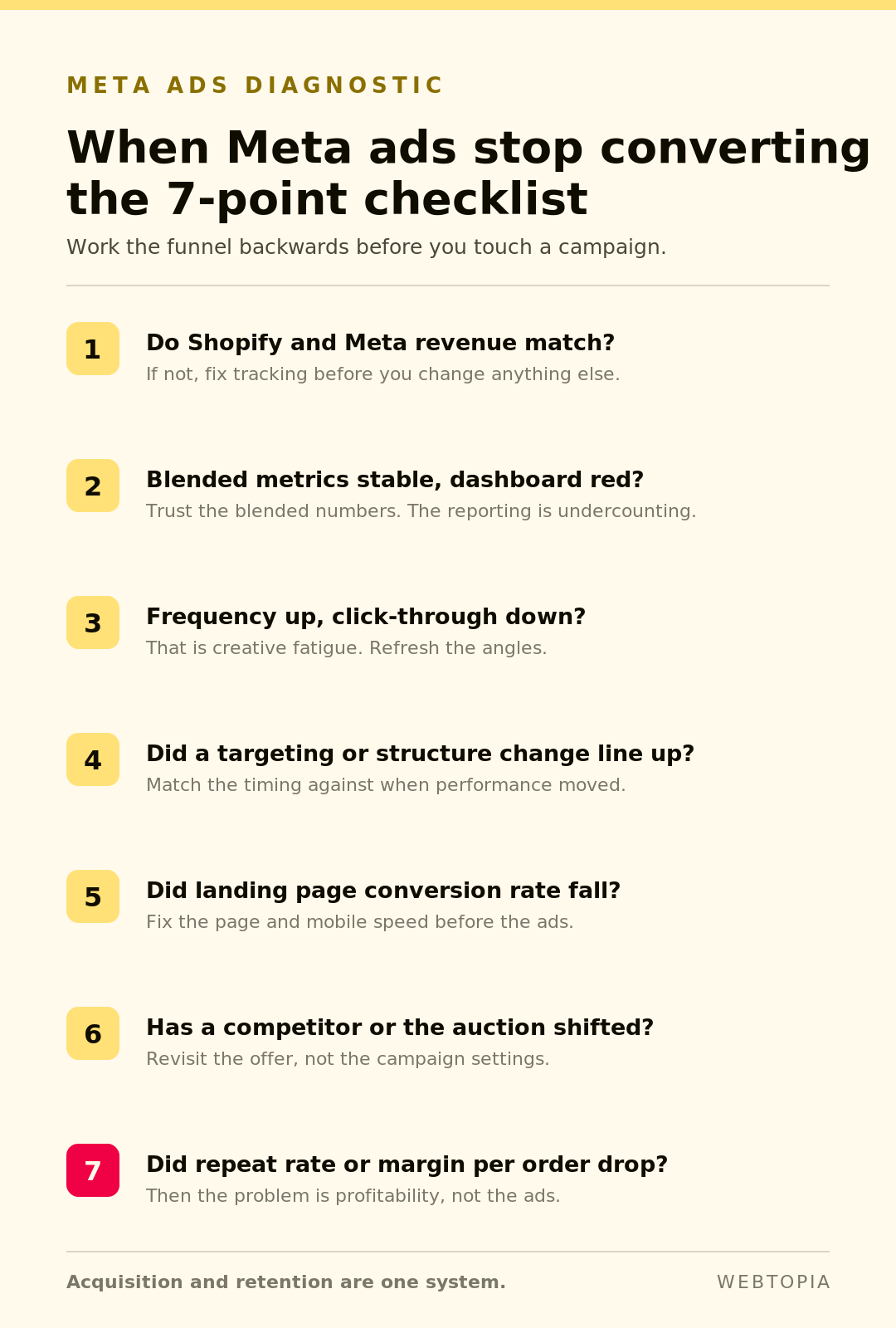
What to do this week
Three concrete actions, in order.
1. Reconcile your numbers
Put Meta-reported revenue, Shopify revenue and blended ROAS side by side for the last 30 days. This single check tells you whether you have a real problem or a reporting one, and it takes an afternoon.
2. Audit creative age and frequency
List every active ad, how long it has run, and its current frequency. Anything old with rising frequency is your first suspect. Brief two or three new angles to test against your tired winners.
3. Walk the funnel on your phone
Click your own ad on mobile data and buy something. Note every second of load time and every point of friction. Most founders are surprised by what they find when they experience the journey their customers actually have.
Where to go next
If you have worked through this and still cannot find the cause, or you suspect the real issue is the maths rather than the ads, that is exactly the kind of full-funnel diagnosis we do. Book a call and we will talk through what your account is telling you, or take a free growth audit and we will map where your funnel is leaking before you spend another dollar trying to fix the wrong thing.
Frequently asked questions
Why did my Facebook ads stop converting suddenly?
A sudden stop is most often a tracking or measurement issue rather than a true performance collapse. Check whether your Conversions API or pixel events broke, and reconcile Meta-reported sales against your Shopify revenue for the same period before you change anything in the account.
How do I know if it is creative fatigue or something else?
Look for rising frequency paired with falling click-through rate on your established ads. That combination is the signature of fatigue. If frequency is stable but conversions still dropped, the cause is more likely downstream, on the landing page, in the offer, or in your tracking.
Should I pause my campaigns while I diagnose Meta ads not converting?
Usually no. Pausing resets learning and can make recovery slower and more expensive. Work the diagnostic first, confirm where the breakage actually sits, then make one deliberate change at a time so you can read its effect cleanly.
What if everything checks out but I am still losing money?
Then the problem is profitability, not acquisition. If your repeat rate or contribution margin per order has fallen, your viable cost to acquire a customer falls with it, and the ads only look broken. Fixing retention and economics is what restores what the ad account can afford to spend.
Get weekly expert insights!
.png)

.png)
.png)
Turn your ad spend into real growth.
At Webtopia, we don’t just run ads. We build scalable growth systems designed for ambitious DTC brands. By combining performance marketing, creative strategy, and data-backed execution, we help founders scale without sacrificing profitability. Our clients see an average 6X blended ROAS every month, because great brands deserve more than short-term wins.
Book your call today and let’s build your next growth chapter together.
